
While they did not mention any country by name, Israel, which has been at war in Gaza since 2023, came close to winning the competition in both 2025 and 2026, ultimately finishing second on each occasion.
Under the old rules, the winning country normally hosts the following year's competition.
Under the new rules, "the winning broadcaster will automatically be ineligible to host the contest if an armed conflict, a sensitive geopolitical situation, or any other situation materially affects the security, safety or stability of their state or immediate region", they said in a statement.
In a first, five countries -- Spain, Ireland, the Netherlands, Slovenia and Iceland -- boycotted the 2026 competition in Vienna over Israel's participation.
They said they could not take part alongside Israel because of its war in Gaza, triggered by Hamas's October 7, 2023 attack on Israel.
Martin Green, director of the Eurovision Song Contest, said in a statement that the changes had been guided by feedback from member countries.
He added: "These changes are about giving everyone involved greater clarity, protecting artists and ensuring the contest continues to provide a safe and welcoming environment, while preserving the spirit and integrity that make the Eurovision Song Contest so special."
Minimum age requirement
The organisers also announced that competitors must be at at least 18, up from 16, on the day of their first rehearsal.
"This change continues the work already undertaken by the contest to strengthen safeguarding and protect younger artists from the pressures associated with competing at the Eurovision Song Contest," they added in the statement.
The youngest person to win the contest was 13-year-old Sandra Kim from Belgium in 1986, according to Eurovision records.
Eurovision is a co-production of public broadcasters belonging to the European Broadcasting Union. Since the EBU includes members from outside Europe, the contest is not limited to European countries.
The EBU said it could commission an independent security assessment before deciding whether a winning country is capable of hosting the event safely.
If a winning country is found unable to host the contest, the EBU will appoint another host nation.
Under the new rules, that country will organise the concert "in its own right" and "will not be required to stage the event on behalf of another member".
Ukraine hosted Eurovision in 2017 despite the conflict in the country's east between Ukrainian forces and Moscow-backed separatists.
But after Ukraine won the contest in 2022, it was unable to host the following year's edition because of Russia's full-scale invasion.
Eurovision 2023 was instead held in Liverpool in Britain on Ukraine's behalf.
Bulgaria's Black Sea city Burgas was chosen to host next year's Eurovision Song Contest, with the final of the world's biggest live televised music event to take place on May 15, 2027, the organisers announced on Thursday.
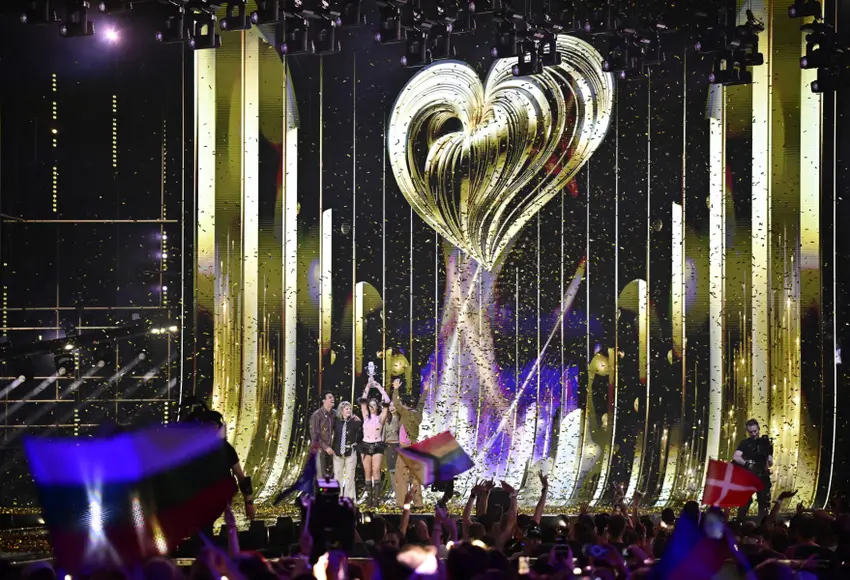
It will be the first time that the Balkan nation hosts the contest after Bulgarian singer Darina Yotova, known as Dara, won this year's contest in the Austrian capital Vienna with the catchy floor-filler "Bangaranga".
"The European Broadcasting Union (EBU) and Bulgarian National Television (BNT) are excited to reveal that Burgas has been selected to host the 71st Eurovision Song Contest in May 2027," they said in a press release.
The semi-finals will take place on May 11 and May 13, with the final on May 15, they added.
Burgas edged out capital Sofia to stage next year's contest following a "complex" evaluation, "covering all EBU requirements," BNT general director Milena Milotinova told a press conference.
Burgas is the second-largest city on Bulgaria's Black Sea coast, with a population of around 190,000.
An important commercial port, it is also one of the main gateways to seaside resorts along the coast, including Sunny Beach, a prime tourist destination for its golden sands.
'An honour'
The contest will be held at Arena Burgas, a multifunctional venue with 5,500 seats that can host up to 15,000 people.
Burgas mayor Dimitar Nikolov said it was "an honour and a privilege" to be chosen.
"Thank you for the unique chance to present Burgas, the region, and the beauty of Bulgaria. We will give it our all to perform at a high level and be remembered as a successful host," he said.
It is hoped the contest will provide a boost for the tourism sector, which accounts for around 8 percent of GDP in one of the EU's poorest countries.
Since its launch in 1955, Eurovision has become the ultimate pop platform, catapulting Swedish icons ABBA to worldwide fame, as well as boosting the likes of Celine Dion, Cliff Richard and Olivia Newton-John.
The 2026 competition was watched by 131 million viewers, down 35 million on the year before after five countries boycotted it over Israel's participation.
Comments